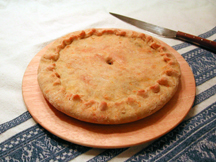
Over the past couple of weeks I've made some major changes to the website, but those changes aren't very obvious.
The most recent changes were also the most noticeable: I've added a bunch of recipes by Jennifer Marshall-Craig and Diana Hart (To Make a Tart, Cinnamon Brewet, Roast Hen, Mushroom Tart, Cherry Sauce, Beef Pie, King's Chicken, Cabbage).
What doesn't show are the changes I made that make maintaining the site much easier. The recipes page is now dynamically generated from a database, as are the pages that list recipes by country and category. This means that when I add a new recipe, I make one entry into the database and the recipe is listed on all the appropriate pages. If I need to make a correction (and I often do), then that correction is also automagically propagated through the site.
For everyone living outside of my head, the benefit of these changes is that the various pages will not become outdated as new recipes are added.
Similarly, the Online Medieval Cookbooks, Recommended Books, and Menus From Medieval Sources pages are also generated from databases. Exciting, isn't it? I know you're just thrilled. I'll try to do something more ... fun (?) ... in the near future.
Friday, April 8, 2011
Behind the scenes on the Website
Friday, February 18, 2011
New Old Cookbook Search
I mentioned in an earlier post that I was redoing the guts behind the Medieval Cookbook Search. Today I'm announcing that the monumental task is now complete (and you probably can't imagine how happy that makes me).
Not only is the search more efficient now, but there are a couple of new features that I think will prove very helpful.
As before, the search page offers the opportunity to search for one or more ingredients in all the cookbooks, or in just a single one.

There's a behind-the-scenes benefit here in that the list of cookbooks is now dynamically generated. This makes maintenance a bit easier.
I also changed the code behind the search algorithm to make it immensely easier to add search terms and update the index files. Because of this I've added a note asking for input and corrections, along with a link to the site's contact page.
Part of my motivation for this rests in a post I read on a mailing list quite some time ago that
noted problems when searching one of the books for the word "wine". Apparently I had inadvertently deleted that search term on one of the times I was working on the index. Now I should be able to correct that sort of problem without trashing something else.
Those changes aren't all that visible though, and probably appeal only to the database geeks out there. The next couple of changes are more useful for the search users.

The recipe display now highlights the found terms within the recipe. This is something I've wanted to do for a while, but the old search code didn't really allow for it.
Beneath the recipe there is still the section I added a while back listing equivalent recipes.

This data comes from a manually maintained database, which means unless I happen across equivalent recipes in one or more cookbooks (or someone else finds them and tells me), and unless I get around to entering the data, there may or may not be anything to show.
The new fun section shows up immediately below the "equivalents".

The "similar titles" section is automatically generated when I build the indexes. It algorithmically pares down the recipe title to its base words, and then looks for other recipes with titles that sound the same (this helps deal with medieval spelling variations).
This feature should help users locate other versions of the displayed recipe, whether I or anyone else has matched them up. I know I'm a geek, but I think this is positively epic (my sons' favorite word lately).
Hopefully the new search code will work well. If you use it and have any comments, I'd love to hear them!

Tuesday, February 1, 2011
Middle-English Words that I Hate
A couple of weeks back I was talking with a friend about indexing texts. She (Hi Drea!) works with medieval dye recipes rather than culinary ones, but we both have the same sorts of problems with trying to search texts that are littered with spelling variations and foreign words.
That conversation got me thinking about, and then experimenting with, a couple possibilities for an improved cookbook search for my website. One of my tests proved to be very functional and much more efficient, so now I've got the new indexing and search interface written and am half way through building new indexes for all the cookbooks.
(While building the indexes is no longer as much work as it used to be - and the new system is a lot more maintainable - it's still a rather labor intensive task.)
Two of the texts I've done so far - "Two Fifteenth Century Cookery Books" and "Forme of Cury" - are the most irritating. They're not only large and loaded with medieval spellings, but they contain many uses of certain words I've now come to loathe.
Pyk - This word, along with its variants (pik, pyke, etc.) can mean pike (as in "Take a fresh pyk and remove the scales") or pick (as in "and then pyk out the bones"). This word is by far the worst, with no consistency in how a given spelling is used. The only saving grace is that "pick" isn't an ingredient, so I could go through the text and mark all the cases where "pyk" meant "pick" so they wouldn't be indexed. Anything left is therefore "pike".
Flowre - There are a surprising number of variants for this one (flour, flower, floure). Indexing them was made a little easier in that a plural always indicates "flowers". One text did have a couple cases where "flower" meant "flour" though, which is really awkward because people who search on "flower" don't want to see recipes with "flour" but do want to see recipes with "flowers".
Eles - Almost as much of a pain as "pyk". Here the many variants (els, elys, etc.) can mean either "eels" or "else". Again though, I only need to index one of the terms.
Grains - For this one I have a different issue. "Grains" can mean ... well, grains, like wheat. Alternately, it could be part of the term "grains of paradise" meaning the seeds of the plant Aframomum melegueta. Generally the plural always means "grains of paradise" and the singular means "grain".
Even though I'm an incredible word geek, after working on these texts I really do hate these words. I also have a renewed appreciation for standardized spelling (or "standardised" for those in the UK).
Wednesday, January 26, 2011
Recipe Interpretation
Last night I tried out a new recipe (a modern one for crab soup, from Chef David Young's cookbook), and that got me thinking about the process I used to interpret medieval recipes. It's really pretty straightforward, but seeing as I'm not the most organized person in the world, it helps keeps me from making mistakes and makes sure I have all the information I need to put the recipes on my website.
[Note for any readers who participate in SCA Arts and Sciences competitions: following this sort of process will also help you document your recipe properly. I'll add notes in brackets where applicable.]
1. Select a Recipe
There are all sorts of ways to do this. You can use a medieval cookbook from a library or bookstore, use one of the many books available free online, or even use my searchable index of cookbooks to find recipes that use a given ingredient.
What's important here is to start with a medieval recipe. If you start with a modern recipe then there isn't much chance you'll end up with something medieval.
Write down or print out the recipe, making sure you spell the words exactly as given in the source.
[You should probably write down a sentence or two explaining why you chose the recipe, like "I had read that turnips were popular in the winter", or "I wanted to make one of the more popular medieval chicken dishes, but wasn't pleased with the versions I'd had before". Make sure you write down the source of the recipe as well.]
[It's also a very good idea at this point to look for versions of the same recipe in other medieval cookbooks. A simple Google search on the title will sometimes turn up . If you're using the Medieval Cookbook Search then sometimes links to other versions will be given at the bottom after the recipe text. Copy these down as well.]
2. Read & Markup
The idea here is to go over the recipe a couple of times, highlighting all the ingredients needed. This serves a number of purposes: it helps familiarize you with the recipe, it lets you know what you'll need to make it, and it identifies any weird steps or ingredients that you may need to look up. This step can be especially important for recipes written in Middle English or some equally obscure language.
[Here you might want to make a note about any hard-to-find ingredients, or unusual combinations of ingredients. Also, if there are other versions of the recipe, compare them to the one you've selected. You might want to combine them into an "average" recipe, or switch to use one of them instead.]
highlighting the ingredients
3. Print a Working Copy
It should have the recipe at the top, along with a list of the ingredients. Keep this close at hand in the kitchen, along with a pen or pencil.
working copy
4. Cook & Taste
Follow the recipe as written, even if you think it's a bit strange. Make sure to write down the quantities of the ingredients you use, along with any places where you did things differently from the original recipe.
Make notes about the good, the bad, and the weird.
not really the recipe above, but it's pretty
5. Share
While sharing the food is nice, sharing your final recipe is even better. Write out a final version of the recipe and post it on a website or email it to friends (or email it to me!).
[By this point you've got all the information you need for your A&S documentation. Add a couple of sentences to link the parts together, format it neatly, check the spelling, set the font to something readable, and you're pretty much done.]
Oh, here is the link to my interpretation of the example recipe above.
Saturday, January 16, 2010
What's in My Google Books Library
The art of bookbinding - Joseph William Zaehnsdorf
Fac-similes illustrating the labours of William Caxton at Westminster - Francis Compton Price
Account roll of the Priory of the Holy Trinity, Dublin, 1337-1346 - James Mills
CALENDER OF THE CLOSE ROLLS
Le vrai cuisinier françois - François Pierre de La Varenne
The forme of cury - Samuel Pegge
Old cookery books and ancient cuisine - William Carew Hazlitt
De opsoniis et condimentis - Apicius, Johann Michael Bernhold
De honesta uoluptate - Platina
The art of cookery, made plain and easy - Hannah Glasse
A new system of domestic cookery - Maria Eliza Ketelby Rundell
Domestic life in England
Early English meals and manners - Frederick James Furnivall
The household of a Tudor nobleman - Paul Van Brunt Jones
Dialogues in French and English - William Caxton
The Complete Works of Geoffrey Chaucer - Geoffrey Chaucer, Walter William Skeat
Le morte Darthur - Sir Thomas Malory, Sir Edward Strachey, William Caxton
The fables of Aesop - Aesop, William Caxton, Joseph Jacobs
Book of Sir Balin - Sir Thomas Malory, William Caxton
L'histoire naturelle des estranges poissons marins - Pierre Belon
The fruit manual - Robert Hogg
Regimen sanitatis Salernitanum - Sir John Harington
Regimen sanitatis - Robertus Gropretius
Regimen sanitatis Salerni - Jean Petit
On early English pronunciation - Alexander John Ellis
Dialogues in French and English - William Caxton
Le Bastiment de Receptes
A collection of above three hundred receipts - Mary Kettilby
Ars magirica - Jodocus Willich, Jachian Bifrun
An Old English miscellany - Richard Morris
Italian weights and measures from the Middle Ages to the nineteenth century - Ronald Edward Zupko
The fifteen O's, and other prayers - Stephen Ayling
The lay folks' catechism - John Thoresby
The lay folks' Mass book - Thomas Frederick Simmons
The Primer; or, Lay folks' prayer book, v1 - Edmund Bishop
The Primer; or, Lay folks' prayer book, v2 - Edmund Bishop
The golden legend: or, Lives of the saints - Jacobus (de Voragine), William Caxton
The New Testament (1852) - James Murdock
The clergyman's vade-mecum - John Johnson
Thursday, June 25, 2009
Even More on "Forme of Cury"
Monday, June 22, 2009
More on "Forme of Cury"
Monday, March 9, 2009
QED
Friday, July 4, 2008
Modern Tools for Medieval Cooking Research
Greg Lindahl has put copies of Cotgrave's 1611 French/English Dictionary and Florio's 1611 Italian/English Dictionary online, and they even have a search feature. I can not even begin to tell you how incredibly useful this was when I started working with Middle French cooking texts. He and Steve Bush obviously put a lot of work into these and have not been thanked enough.I originally created this searchable index for my own use. I wanted to be able to find recipes in Two Fifteenth-Century Cookery Books by ingredient, and because of the weird spellings used in the book, regular search engines were useless. It's far from perfect, but until something better comes along it'll do.
Billed as " a reusable non-linear personal web notebook", Tiddlywiki is a strange little program. It's essentially a small, modifiable web site packed into a single file. Right now I'm using it as a sort of storage space for all the things I would normally write down on a piece of paper to remember later and then leave in my pocket to go through the laundry and then be left with a lump of paper and a feeling that I've forgotten something important. I upload the file and keep it where I can get to it from any computer hooked to the Internet (as a bonus, it's completely platform independent). I'm sure there are other uses I haven't thought of yet - it really is a neat little program.
Aside from the museums and libraries that have one or two useful texts that they've made freely available online, the Internet Archive and Google Books have put an immense number of texts out there for anyone to get to. It can still be pretty hard to find things, but with the enormous volume of books they've got, it's certain there is something in there that you would find useful.