Wednesday, April 30, 2008

Not Jelly

A couple of weeks back I posted about a batch of cormary I made up where the broth unexpectedly turned into jelly.  Of course, being of the geek persuasion, I had to try to make meat jelly the same way ... but intentionally this time.  Naturally, it didn't work.

What I did was to put a 4 pound pork loin into the slow-cooker with 4 cups of white wine, and cooked it all until the meat fell apart. I think I put in a bit of salt too. I thought that this was the same proportions of meat-to-wine as I used in the aforementioned incident.

What I ended up with (aside from the meat which was used for barbecued pork sandwiches) was a quart of really nice soup stock. Excellent flavor, nice body, beautiful color and clarity, but still not jelly.

Bother!

So now I need to figure out what went wrong and try again (and again ... and again). It could be that I misremembered the proportions and got too much wine in there - diluting the jelly to the point where it won't ... um ... jelly. It might also be an issue of having used white wine instead of red. Lastly, I used the slow-cooker this time instead of a covered dish in the oven.

I think I'll try using less wine and baking the pork in the oven - that'll take less time and materials, if nothing else. I hate it when an experiment fails! Good think I'm not a TV chef. I can just hear the hushed voice-over, "Now chef Myers is dumping the contents down the garbage disposal and starting all over again."

Thursday, April 24, 2008

Waffle! Waffle! Waffle!

My family and I spent the week after Easter on vacation, and the house we stayed in had full cable. This of course led me to watch many many hours of Food Network programming, including several episodes of Good Eats. Now I like this show - it's entertaining and educational, and most of all it's about food. How cool is that?

However, every now and then Alton Brown's food historian would let loose with some bit of absolute, unsupportable nonsense. 

For example in the episode on waffles, the food historian stated something to the effect that waffles developed from the sacramental wafers of the middle ages. This caused me to pass root beer out my nose and to say something rude to the television.  Let's just say that didn't sound right to me.  So now I'm compelled to look into the history of waffles.

I'll start off with a nice painting ...


waffles, ca. 1567


Click on the link and take a closer look. See those things in the lower-left corner? Waffles. Very modern looking waffles for that matter.

There are a handful of medieval recipes for things called "waffles", "wafers", and even "guaffres", but they all describe something that sounds like the thing above. Some of them call for a slice of cheese to be encased in the batter before waffling, others have ground-up fish parts mixed into the batter ("Mmmm ... fish waffles").

There is one reference in Menager de Paris (France, 15th c.) that describes something less waffle-like, but it sounds more like a pizzelle than a wafer, and another from The English Housewife (England, 17th c.) that is definitely a pizzelle. Neither really supports the claim that waffles came from wafers though.


medieval waffle iron
(looks like a pizzelle maker to me)


What about medieval sacramental wafers? Well in medieval England and France sacramental wafers were called "obleys", not "wafers" (the word "obley" comes from the same source as "obligation"). So it appears at the time that waffles (by any name) and sacramental wafers were already two distinctly different things.  

Interestingly, Mayhew and Skeat's Concise Dictionary of Middle English defines "wafer" as "a thin small cake" and notes that it comes from the Old High German "waba" meaning "honey-comb".

So I'll accept that the terms "waffle" and "wafer" were used indiscriminately throughout much of the middle ages, and even that sometime in the late middle ages the meaning of "wafer" evolved to include sacramental wafers. But saying that one of these two items is derived from the other is bunk.

Sunday, April 20, 2008

Discworld Cake

Ok, this isn't at all medieval - even back then they knew the world was round - but this has to be one of the most incredible cakes I've ever seen.


Of course they did use marzipan and sugar paste to make edible sculptures in the middle ages. Such sculptures were often referred to as "sotlties" or "entrements". Unfortunately I've seen very few attempts by medieval re-creationists that approach this level of intricacy or artistic skill (and the tree of butterflies I made some time back out of sugar paste pales in comparison).


I am so in awe of this artist.

Thursday, April 17, 2008

Accidental Jelly

A good while back, Kristen (my apprentice) managed to get a hold of some cow's feet and tried making meat jelly.  She used a recipe from Two Fifteenth-Century Cookery-Books (included at the end of this article), however her project never quite ... well ... gelled.  That is, it didn't set.  What she ended up with was a large amount of cow-foot soup.

Fast-forward to last Friday when I was preparing food for a royalty lunch.  One of the recipes I made was Cormarye - a sort of marinated, roast pork.  I had a lot of dishes to make, so I cut a few corners, tweaked the recipe a bit, and stuffed it into the oven for a couple of hours.  It smelled absolutely yummy when it came out, so I let it cool, sliced it up, and put it in a sealed container in the fridge overnight.

The next morning I discovered something weird had happened.  As it sat overnight, the wine broth that the pork cooked in had turned to a dark red jelly. Funky. It hasn't done that before. So what had I done differently this time? This is something that I need to figure out if I'm going to intentionally make meat jelly.

The key was in the short cut I took. I used a 4 pound pork loin in a roasting pan that was just big enough to hold the pork and the wine - and therefore left out the broth. I'd figured there was enough liquid to keep it from burning and keep things moist, so what the heck.

Wine is often used when cooking meats since it helps break down connective tissues, and thus makes the meat more tender. This same connective tissue is one of the sources of gelatin (along with bones, hooves, cartilage, hides, and all sorts of other parts that the corporations who sell fruit-flavored gelatin don't want you to think about). Now normally when I make Cormarye I add in some broth. I hadn't realized it, but that broth dilutes the gelatin and keeps it from setting properly. This time when I left it out the gelatin remained un-diluted and could set. Neat.

So all that remains now is to see if I can duplicate this process using white wine instead of the red (which will allow me to color it bright yellow with saffron) and to leave out the seasonings used in Cormarye (so I can flavor it as desired). If so, then I'll have an easy way to consistently make medieval meat jelly and won't need to resort to unflavored gelatin packets - or for that matter cow feet (yeah, you try to find cow feet at the corner grocery).


Medieval Jelly Recipe 
from Two Fifteenth-Century Cookery-Books

Cix - Gelye de chare. Take caluys fete, and skalde hem in fayre water, an make hem alle the whyte. Also take howhys of Vele, and ley hem on water to soke out the blode; then take hem vppe, an lay hem on a fayre lynen clothe, and lat the water rennyn out of hem; than Skore a potte, and putte the Fete and the Howhys ther-on; than take Whyte Wyne that wolle hold coloure, and cast ther-to a porcyon, an non other lycoure, that the Fleysshe be ouer-wewyd withalle, and sette it on the fyre, and boyle it, and Skeme it clene; an whan it is tendyr and boylid y-now, take vppe the Fleyshe in-to a fayre bolle, and saue the lycoure wyl; and loke that thow haue fayre sydys of Pyggys, and fayre smal Chykenys wyl and clene skladdyd and drawe, and lat the leggys an the fete on, an waysshe hem in fayre water, and caste hem in the fyrste brothe, an sethe it a-3en ouer the fyre, and skeme it clene; lat a man euermore kepe it, an blow of the grauy. An in cas the lycoure wast a-way, caste more of the same wyne ther-to, and put thin honde ther-on; and 3if thin hond waxe clammy, it is a syne of godenesse, an let not the Fleyshe be moche sothe, that it may bere kyttyng; than take it vppe, and ley it on a fayre clothe, and sette owt the lycoure fro the fyre, and put a few colys vnder-nethe the vesselle that the lycoure is yn; than take pouder of Pepir, a gode quantyte, and Safron, that it haue a fayre Laumbere coloure, and a gode quantyte of Vynegre, and loke that it be sauery of Salt and of Vynegre, fayre of coloure of Safroun, and putte it on fayre lynen clothe, and sette it vndernethe a fayre pewter dysshe, and lat it renne thorw the clothe so ofte tylle it renne clere: kytte fayre Rybbys of the syde of the Pygge, and lay ham on a dysshe, an pulle of the lemys of the Chykenys, eche fro other, and do a-way the Skynne, and ley sum in a dysshe fayre y-chowchyd, and pore thin gelye ther-on, and lay Almaundys ther-on, an Clowys, and paryd Gyngere, and serue forth.

Wednesday, April 9, 2008

Medieval Cookery at GenCon

It's official. I will once again be giving a seminar on medieval cooking at the GenCon gaming convention in Indianapolis. This year's topic is Medieval Food Preservation. Here's the seminar description:


SEM00064 - One for the Road: Medieval Food Preservation
D&D characters have their "hard rations" and Tolkein's elves had "lembas", what are your characters going to eat while traveling? Find out about real traveling food in the middle ages: what foods kept well, what foods didn't, and what was the best way to keep meat from spoiling. 8/14/08, 8:00 PM


I gear these seminars towards writers and game designers who want to add more historical accuracy to the worlds they create. The ones I've done in the past have been great fun - I get lots of good questions from the audience. I'm still researching the topic but from what I've learned so far, I think a lot of people will be very surprised.

Tuesday, April 1, 2008

Sugar is sweet ...

Quite a while back I put some notes on the website about medieval sugar. They're all extracts from cookbooks and such detailing the types of sugar available - the color (white, brown, black) and the form (loaf, cone, powder). My main reason for digging up these references was in part to counter a statement I'd often heard that they didn't have powdered sugar in the middle ages.


Of course I couldn't directly prove that they did have powdered sugar - that seems to be an impossible task. What I could show is that they had something they referred to as powdered sugar, and that given the common kitchen tools and processes of the time it is trivial to grind sugar into a powdered form (interestingly enough, I did find an early 17th century source that says to add starch to powdered sugar to keep it from clumping - which is done modernly). While this isn't positive proof, it does make the case strongly enough to be reasonably certain.


One question about sugar that I couldn't answer this way was about its color. While they did referr to some sugar as being "white", there is no way to know if they really meant white, or if they just meant "light colored". Now to my rescue come a couple of illuminated manuscripts which actually depict sugar!


One comes from a book called Tacuinum Sanitatis - a sort of medieval book on health and wellness. It was originally an 11th century Arabic manuscript, and was translated and copied all over Europe throughout the middle ages. In the picture below from one edition from Italy in the late 14th century, there is a depiction of a sugar merchant selling white chunks.


Theatrum sanitatis, codice 4182 della R. Biblioteca Casanatense. Rome


Pretty conclusive, but it's nice to have a second opinion. So here is a market scene from a different manuscript. In the lower right is a spice merchant with a large white cone of sugar.


La rue marchande, Le Livre du gouvernement des princes
Paris, BnF, Arsenal, manuscrit 5062


Again, it seems pretty clear. The artists chose white paint for the sugar instead of just letting the beige background color to show through. If sugar were commonly brown or black or beige then they would have used those colors instead. Is this positive proof? Well ... no, these could be exceptions, but taken with the textual evidence it becomes very very compelling. Time to update my sugar notes.

Monday, March 17, 2008

On Baking Rice

One of the neat tricks I've learned from talking with caterers and the like is that when you're cooking rice for a lot of people (e.g. 120) you can bake rice instead of boiling it. The rice goes into a steamer pan with the same amount of water that you'd use to boil it, and then it's covered tightly and put into an oven for an hour. This method has the benefit of being less time-sensitive than boiling, and you don't have to worry about it burning on the bottom as the stuff in 30 quart stockpots often do.


A couple of days back I decided to try cooking frumenty this way. Frumenty is essentially a thick cracked-wheat porridge. I've tried making it at a feast once or twice and it always gave me trouble. Sometimes it just took too long to cook, other times it burned. The wheat is boiled in the same way as rice, so it seemed like a perfect candidate for baking.


I put a cup of cracked-wheat into a deep glass baking pan along with two cups of water, covered it with aluminum foil, and popped it into a 350°F oven. An hour later I took it out to check on it - huh ... too soupy and the grains were still a bit too crunchy. Back into the oven it went. I checked it another hour later and it was perfect. So frumenty can be cooked this way, and it is a lot easier, but it takes longer. Not a bad trade-off. I'll have to remember to update my recipe for frumenty to reflect this.


Days later the thought occurs to me: did they ever bake grain in the middle-ages instead of boiling it? This can be a hard sort of question to answer for certain, but I can look for evidence in the medieval cookbooks. There are lots of medieval recipes for rice, and at least a couple from each country. I start reading through them and after a while things begin to blur - they all sound about the same. Wash the rice, put in a pot with some liquid (e.g. water, broth, milk), and boil. Some add other things like meat or rice-flour or almond milk. Some add saffron or other spices. All of them say to boil it.


I didn't find a single recipe for rice or wheat that said to put it in a pot with liquid, cover it, and bake it. Ugh.


So then I'm forced to ask myself why? This is a cooking method that is perfectly suited to medieval European cuisine. The dish will turn out perfectly for a huge range of time and temperature. Why wouldn't they cook it this way? I don't have an answer for this, but I will veer off into speculation for a moment here.


The setup of the medieval kitchen, and especially the oven, was functionally different in a couple of significant ways. The ovens were usually heated up early in the morning by filling them with wood and sealing them up. When the oven was hot enough (around 500°F) the ashes were shovelled out, the floor of the oven was wiped out, and the bread baking began.


Interestingly enough, the ovens were often in a separate room from the kitchen. Sometimes they were in a completely different building. In small towns you could take your bread dough to the baker to bake it in their oven. While boiling rice is easy enough over a fire, and baking it is easy in a modern kitchen, it would be much more awkward to do if the oven were elsewhere. Not impossible, mind you, just more awkward.


I suspect that it just never occurred to any medieval cook that they could bake rice. Heck, it didn't occur to me, and I've got an oven right in my kitchen that heats to a consistent temperature at the push of a button. We modern cooks also use our ovens for a larger variety of foods - we "roast" meats there instead of over an open fire, and we bake vegetables like potatoes or turnips. In the middle ages, ovens were generally used for bread and pies - things made of or enclosed in dough.


So it looks to me like baking rice is one of those thinks like the sandwich. They could have done it - they had all the stuff to do it - but they just never had the idea, and so they didn't.


Of course I could be wrong, and I'd be overjoyed if someone found a recipe for baking grain instead of boiling it.

Tuesday, March 4, 2008

Thoughts on Pepper

The other night I was cooking dinner, and as I was seasoning whatever it was, a thought occurred to me. Why pepper? On just about every dinner table here in the US, on almost every restaurant table as well, are two spice containers: salt and pepper.


The salt I can understand. There's a biological need for salt, and since it was hard to come by in human pre-history, an innate desire for salt has developed. But what about the pepper? Pepper has no function in human biology, so there's no built-in drive to eat it. The only reason we put it on our food is for taste, and that's no different from any number of other spices. So why has pepper become more common than ginger or cinnamon or mint?


My first thought is that it might be a carry-over from earlier habits. Salt is one of the most commonly used spices in medieval cookbooks. Perhaps pepper was too, and since cooks sometimes do not put enough spice into a dish, maybe it became the practice to have the two most common spices set out on the table to allow the diner to suppliment a dish's flavor. As a quick check for this, I looked to see how often pepper shows up in medieval recipes.


I have some statistics from medieval cookbooks already compiled ... Unh. Not very conclusive. Below is a list of the four most common spices from various cookbooks.

Enseignements (France, 1300): Pepper - 50%, Ginger - 35%, Cinnamon - 28%, Mustard - 26%

Forme of Cury (England, 1390): Salt - 47%, Saffron - 39%, Ginger - 23%, Pepper - 14%,

Du fait de cuisine (France, 1420): Salt - 81%, Ginger - 70%, Grains of Paradise - 62%, Pepper - 41%

Liber cure cocorum (England, 1430): Saffron - 34%, Salt - 31%, Pepper - 27%, Ginger - 20%

Two Fifteenth-Century Cookery Books (England, 1450): Salt - 56%, Ginger - 42%, Saffron - 41%, Pepper - 31%

A Proper newe Booke of Cokerye (England, 1550): Salt - 36%, Cinnamon - 30%, Ginger - 22%, Mace - 18%

The Good Housewife's Jewell (England, 1596): Ginger - 40%, Pepper - 40%, Salt - 40%, Cinnamon - 35%


At a glance, we can probably leave out the grains of paradise and the mace - they both only make the top four of a single book. Salt makes the top four of 6 books, and is the number 1 spot for 3 of them. Pepper also shows up in 6, but is the top spot for only 1. Ginger is in the top four of all 7 books, and is in the top spot for 1. Also, ginger ranks higer than pepper for 5 of the books. Why don't we have a ginger shaker on the table then?


It looks like I need to do more digging ...

Sunday, March 2, 2008

Humbles of Venison

Several months back I was looking for venison recipes and came across a recipe in "The Good Housewife's Jewell" (England, 16th c.) titled "To bake the humbles of a Deere." I didn't have any deer kidneys on hand, so I tried it out with ground venison instead. It was ok, but nothing to make a fuss over, and something seemed a bit strange with it. So I took a closer look at the source and did a bit of digging.


The first thing that I found was that the two different editions I had of the source were not in total agreement. One edition called for dates where the other (which I'd used) called for oats (spelled "oates"). A bit of a discrepancy there. Which one was right? I checked with an authority on the source (Hi, Johnnae!) and learned that in the microfilm version the word is clearly dates.


But this left me without much of a binder for what I'd initially assumed was something like meatloaf (yes, a faulty assumption - even I do this from time to time). A quick look at the adjacent recipes in the text and it was fairly clear that the recipe was most likely a pie. No problem. I'll make it as a pie then and see how it turns out, only this time I figured I'd get some deer kidneys and do it right.


Hence the delay. Apparently deer kidneys aren't something that can be purchased in one-pound packages at the local supermarket. Neither are they available at the butcher shop, or even (gasp!) at that mecca of food-enthusiasts, Jungle Jim's. I asked some hunters I knew and learned that they usually discard the kidneys along with the rest of a deer's innards. So I asked those same hunters if maybe, please, pretty-pretty-please, if they get the chance would they save the kidneys from their next deer for me? I got more than a few weird looks and some hesitant "Ok"s, and then I waited.


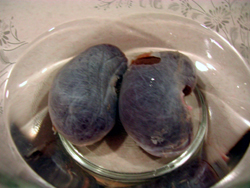
At the point when I'd all but forgotten what I wanted them fore, my apprentice presented me with two deer kidneys that had formerly belonged to a deer which had been shot by her uncle (Kristen's uncle, not the deer's). They were smaller than I'd expected, and were slightly disturbing to hold - they felt kind of like a small bag filled with jello.


deer kidneysdeer kidneys


At last we had real deer kidneys, so of course we had to cook them. I dug up the (corrected) recipe again and looked it over.


Source [The Good Housewife's Jewell, T. Dawson]: To bake the humbles of a Deere. Mince them verie small, and season them with pepper, Sinamom and ginger, and suger if you will, and cloues & mace, and dates, and currants, and if you will, mince Almonds, and put unto them, and when it is baked, you may put in fine fat, and put in suger, sinamom and ginger, and let it boile, and when it is minced, put them together.


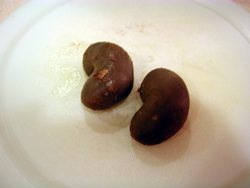
The first question that sprang to mind was whether the kidneys should be cooked before using them - I vaguely remember a hunter joking about needing to "boil the piss out of them". We did a quick check of the other medieval recipes for deer kidneys and found that most of them did indeed specify boiling as the first step of the recipe. So I popped them into a small pot of water and let them boil. It was a bit creepy, really, because I could see a thin trail of blood streaming out of the kidneys as they boiled. Once this stream stopped I figured they were cooked well enough.


deer kidneysboiled deer kidneys


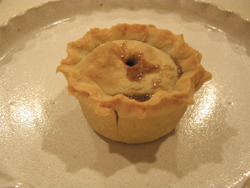
They'd shrunk a bit - we were obviously going to have just enough for a small pie. They also felt like they'd bounce pretty high if dropped. More like a superball than cooked meat. The recipe starts with mincing them "verie small", so I got out the chef's knife and did just that. Tedious, but not difficult. The rest of the recipe was quick and easy, we mixed everything all up, put the filling into a pastry-lined ramekin, covered it, and popped it into the oven for a half hour or so. When the crust looked done, I melted some butter, added the spices, and poured as much into the pie as I could (it overflowed a bit).


deer kidneysvery small pie


Of course the proof of the pudding (and apparently the pie) is in the eating. The apprentice and I looked at each other for a moment. People have been eating kidneys for a long time, probably as long as there have been people, so it has to be ok to eat. It's meat, it's well cooked, and it has all sorts of good-tasting stuff in it. With a bit of a mental shrug, we passed around the forks and cut the pie.


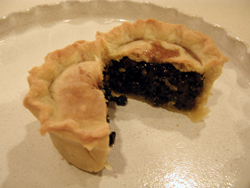
deer kidneysvery small pie, opened


Not bad at all, really. I don't know what I expected - maybe more of a liver sort of taste. It's basically a mincemeat pie. The flavors of the spices, fruit, and butter pretty much drowned out everything else. The meat was a bit chewy in spite of being minced, but it wasn't bad enough to put me off kidneys. In the future I'll probably be making this with venison steaks or ground meat, as it's a lot easier to get and it won't have any substantial effect on the flavor.

Wednesday, February 27, 2008

An Interview

Ohio State University's Center for Medieval and Rennaissance Studies interviewed me for their monthly newsletter, Nouvelles/Nouvelles - the current issue (with the interview) is on their website as a PDF document. This is way cool! Since they're only an hour and a half drive for me, I'm hoping we can set up some kind of cooking demonstration/talk thing for this spring or later this year.

Tuesday, February 12, 2008

Gas vs. Electric

While considering the potential renovation of our home kitchen the issue of choosing a gas or electric cooktop came up, and a strange thought occurred to me (big surprise, I know - me having a strange thought - you'd think I was used to it by now).

The most common preference among cooking enthusiasts is gas, which allows you to quickly adjust the amount of heat being applied. Not so for electric, where the heating element takes long enough to cool down that it adds a significant challenge to making temperature-sensitive recipes (like many modern French sauces). In spite of being plumbed for gas, we have an electric cooktop.

In fact, I've been cooking on electric stoves for the past 24 years. You get used to it, really. You learn to move the pan around a lot, have it hang halfway off the element as it cools down, or lifting it up an inch or so for a minute. This makes my cooking style a bit funky when I'm working on the nice new gas stove at my mom's.

So my initial reaction was to go with a gas stove. After all, you can't get more medieval than cooking over fire, right?

Then I thought back to last summer, when I did a bit of cooking over a real fire using an earthenware pot. I had Helewyse de Birkestad (Louise Smithson) with me to show me the basics, and the first thing I learned is that I wasn't going to be cooking over flame. Instead we had the pot on a grill over coals. This gives a much more constant and even heat. So here's the kicker: how did we control the amount of heat applied to the pot? By moving it around. As the coals cooled down the pot got moved closer in. If it boiled a bit too much it got moved away - or was raised up a bit.

So maybe the past 24 years of electric cooktops was good training.


Monday, February 11, 2008

My Shopping List

There are a number of books on my shopping list right now, so I thought I'd mention a few of them (in no particular order).


Food in Medieval England: Diet and Nutrition

C. M. Woolgar
This book sounds like it combines information from a diverse range of fields. Woolgar's previous works are wonderfully detailed and supported, so this one sounds really promising.


The Book of Sent Soví: Medieval recipes from Catalonia
Joan Santanach (Editor), Robin Vogelzang (Translator)
I'm mostly into English and French cooking history, so why this? Catalan borders on France, of course, and there's almost nothing out there on medieval Catalonian cooking. How much does it resemble that of its neighbors? What ingredients are similar? What are the differences. I just gotta know!


Cooking and Dining in Medieval England
Peter Brears
Brears is one of those authors that, when they put out a new book, I pay attention. The combination of the subject with Brears' usual level of scholarship sounds very promising.


Saturday, February 2, 2008

Researching Medieval Recipes

Physicists sometimes refer to "The Arrow of Time" - the apparent directionality of how time flows. Apparently there are some sub-fields of physics where this is a big thing. To those of us outside of that academic world, this seems like a "Duh!" kind of thing, and one wouldn't think it is worth considering in the area of historic research.

It is.

When people look at medieval cookbooks, there seems to be a strong desire to ignore the inherent directionality. I think it's part of a built in human need to generalize - to make sense of something that does not fit in with the current world-view.

Ok, that's a bit too philosophical. Let's try some examples.

Let's say you've got this recipe that's been in your family for many generations. One day while serving it to some family or friends the thought hits you that all the ingredients in it were available in medieval Europe. "This might be medieval," you think, and decide to look into it. You then spend months digging through the cookbooks, trying to find recipes with the same ingredients, where similar methods were used, and where the end result sounds similar to the dish you know and love. If you're really really lucky you find an exact match. More likely though is that you find a few "kind-a, sort-a" recipes from widely varying times and places, and then you give up in frustration and tell people that researching medieval recipes is hard.

It's not, really. It only seemed hard because you ignored the directionality of time. You latched on to a piece of modern information and tried to push it some 500 years into the past. You assumed that because all of the ingredients were available in the middle ages, that there must be a cook somewhere back then that made this recipe. [This kind of reasoning is proven invalid by recipes like mayonnaise - all of its ingredients were present back to ancient times, but it wasn't invented until 1756.]

The easier way to research medieval recipes is to keep the information flowing from the past to the present. Pick up (or download) a medieval cookbook and treat it like you would any other cookbook. Read through it, skipping here and there, looking for something interesting, something that sounds tasty or different or that you have all the ingredients called for. If you can't read Middle French or German then use someone else's translation. If you can't read Middle English, borrow (or download) a dictionary and practice - it's mostly funny spelling and a handful of archaic words.

So you've picked out a recipe. Now gather the ingredients and follow the instructions. It may take a couple of tries (or three, or four) before you get the quantities balanced so the flavor and consistency are so you like it - most medieval recipes inconveniently leave out any measurements). You may even find some recipes that sound good but turn out just plain nasty (I've done this, but I've also found such recipes in modern cookbooks). Once you've found a good recipe though, then you've got a truly authentic medieval dish, and you've also got the original source it came from - documenting it becomes a trivial matter.

Of course every now and then, while browsing through a medieval cookbook, you're reading a recipe and the realization hits you, "That's grandma's recipe!" - and you find out that in medieval times they put raisins in it.


Monday, January 21, 2008

It's really not that hard ... Part 2

So ... I'm going through the calendar, trying to figure out which medieval re-creation events I'll be going to for the next few months, and I take a look at the feast menus, and I find that some of them don't even give a hand-waive towards history. Yes, there are some nice, medieval (or at least reasonably so) feasts here and there across the Midwestern US, but they appear to be decreasing in proportion to the others.

I'll pause here to note that I've been in the SCA (a US-based medieval "re-creation" group) for many years, and I've been cooking for much of that time. I'm the first to admit that the feasts I cooked way back when were crap as far as historical accuracy goes, but then there weren't the resources available back then that there are now.

I know I'm a food snob, that I'm fanatical and bordering on dangerously obsessed, but I don't think I'm asking too much here. All I want is a reasonable attempt at medieval food. I don't expect a six course meal, with four or five dishes per course, all exotic and unusual and documented to have been served to a duke in Calais in the year 1432 (I wouldn't complain, mind you, but I really don't expect it). However it really isn't that hard to come up with a filling meal consisting of a few dishes that are reasonable approximations of what might have been served to someone - anyone - between the years 600 and 1700.

Really, it's not that hard. Let's say that - for whatever reason - you've got to cook a medieval dinner. Can a reasonable attempt be made assuming no prior knowledge of medieval European cuisine, no ability to read a language other than modern English, no local library with texts on the subject, and no fancy cooking skills? Yes. All it takes is Internet access (or a friend with Internet access).


Web Search

A Google search on "medieval recipe" returns 224,000 hits - I'm only going to look at the first two.

The first link, titled Medieval Feasts, has 11 recipes. Among them I find:
  • chicken with orange and lemon
  • spinach tart
  • frumenty, a cracked wheat side dish for meats
  • cherry pottage
That's a meat dish, a vegetable, a starch, and a dessert. Add bread and butter and it sounds like a really nice meal. All of these have complete recipes with detailed instructions and even a reference to the original source - and it took me a whopping two minutes to put together.


The second link is to a site I know pretty well - it's my own Medieval Recipes page. It lists over 90 recipes, each with detailed instructions and a reference to the original source.

What's more, there's a big button at the bottom of the page that says "Menus". This leads to another page with links to both menus from medieval sources, and menus from the feasts of re-enactment groups.

Obviously digging through this site could chew up more than a couple of minutes, but it also offers a lot of choices (now that I think about it though, I'll be adding a "Quick and Easy Medieval Feasts" page soon).


Let me say that again: Two Minutes

Two minutes got me a reasonable attempt at a medieval dinner, and there were lots of other options with just a few more clicks. I didn't have to go to a library. I didn't have to open a book. I didn't have to try to read a different language. I didn't have to work out a recipe on my own.

Don't try to tell me that it takes too much work to do it right.


Friday, January 18, 2008

Making a Medieval Field Kitchen - Part 2

Foods for Medieval Field Kitchen

In my first post I talked about the furniture and equipment I'd need. Here I'll be looking at the foods. Come to think of it, this is probably my computer science background showing through - first I speced out the hardware, now I'm doing the software.


Italian Kitchen from "Il Cuoco Segreto Di Papa Pio V",
Bartolomeo Scappi, Venice, 1570


As a source of raw data, I used lists of foods I'd pulled out of medieval English and French cookbooks for the section of my website on Statistics from Medieval Cookbooks. Since I know which foods appear most often in the cookbooks I work from, I can ensure that I have the majority of ingredients I might possibly need.

These foods seem (to me) to divide themselves into four categories: Spices, Staples, Fruits and Vegetables, and Fresh Foods.


The Spices

This category is pretty simple to deal with. They don't take up much space, so I should be able to keep them all in a "spice chest" the size of a shoebox. As long as I keep them dry, I don't have to worry about them. The spices are: cinnamon, cloves, cubebs, cumin, ginger, galingale, grains of paradise, hyssop, mace, marjoram, mint, mustard, nutmeg, parsely, pepper, saffron, sage, salt, sandalwood, and savory.


The Staples

These are the foods that I'll need in larger quantities than the spices, but like the spices they'll be fine as long as I keep them dry (or for the liquids, in suitable containers). The staples are: almonds, amidon (wheat starch), cooking oil, flour, lard, nuts, oatmeal, peas (dried), pine nuts, rice, rosewater, sugar, vinegar, wine, and yeast.

Hmm... suitable containers - there's a whole new problem. I really can't have an authentic medieval field kitchen if I have a plastic bottle of olive oil and commercial spice tins sitting out on the table, can I? Obviously I'll need to look into medieval food containers - but that can wait until later on.


Fruits and Vegetables

This is a bit of a mixed bag. Most of these will keep reasonably well for several days (assuming good weather). A few (e.g. apples, onions) have a high enough moisture content that I'll need to keep an eye on them to make sure they don't go all green and fuzzy on me. They are: apples, currants (zante raisins), dates, figs, garlic, onions, oranges, prunes, and raisins.


Fresh Foods

These are the troublemakers. The fruits and vegetables on this list won't keep as well as those on the list above, and some of these foods will quickly become unsafe if kept at room temperature. They are: cabbage, cream, grapes, leeks, mushrooms, pears, radishes, spinach, strawberries, turnips, butter, eggs, cheese, meat, and milk.

Most of these will need to be purchased on the day they're to be used. There are some medieval preservation techniques that could help - especially with the meat - but again, that would be (and will be) a whole separate topic.


Sunday, January 13, 2008

Making a Medieval Field Kitchen

A while back I came across the picture below, and of course it got me thinking. "Field kitchen? I could really use a proper medieval field kitchen."


Field Kitchen from "Il Cuoco Segreto Di Papa Pio V",
Bartolomeo Scappi, Venice, 1570


You see, every now and then (at least once a year - and it should be much more often) I go to a medieval camping thing. In the past I've avoided doing any serious cooking (kind of embarrassing to admit), which I usually attribute to lack of equipment and not wanting to cook over a fire on hot days. But seeing this picture has made me realize that the equipment needed for a proper medieval camp kitchen might not be all that hard to put together at a reasonable cost. I'd still have to be cooking over a fire on hot days, but I suppose I should just accept that as part of the whole medieval experience, eh?


So ... just what do I need for a properly working - and safe - kitchen?  In terms of furniture, I don't need an awful lot as long as I'm not trying to be too fancy.
  • two saw-horse tables
  • a roasting rack
  • a sun / rain awning
  • some shelves to keep stored items off the ground
  • boxes and baskets for food storage
That's pretty encouraging, especially since I already have the roasting rack - it doesn't even look too different from the one in the picture.  The list for kitchen equipment is quite a but longer though.
  • two or three earthenware pots
  • tripods / trivets
  • mortar and pestle
  • wooden spoons
  • a meat hook
  • a cauldron or large kettle
  • an S hook
  • a griddle
  • a wafer / waffle iron
  • pitchers
  • wooden bowls
  • serving platter
  • knives
  • hand towels
  • dish towels
  • tablecloths
I think I have about half of these, and some of the remaining could get pretty expensive (have you priced large wooden bowls lately?  The real ones, not the cheap salad things).  Then there's a list of things I need for the sake of food safety and cleanliness.
  • three wash tubs
  • dish soap
  • dish sanitizer
  • water dispenser for washing hands
  • bucket for waste water
That's a lot of stuff, but really it's not too bad.  Notice something though?  I didn't list any food, and I didn't list anything for keeping foods fresh.  That's a whole topic on its own, and I'll cover it in the next post.


Monday, January 7, 2008

Mystery Objects

As a food-geek, I often find myself looking at the wrong part of a painting. Presented with a medieval scene depicting Joseph and Mary on their way to Bethlehem, I'm ignoring the figures in the foreground and instead stare at some small plant in the background mumbling something like, "Is that a carrot?" Occasionally I'm even quite annoyed at the subjects in the foreground for being in the way.


To the rescue come the late-medieval Flemish artists, who decided that the setting was much more fun to paint and therefore relegated the action of the painting to the background. The resulting still-life paintings often contain all sorts of interesting food-related items, and the main characters don't get in the way. A fine example is the painting by Pieter Aertsen commonly called "The Butcher Stall" - though apparently it's meant to be "The Flight into Egypt."


Butcher's Stall (1551)
Pieter Aertsen


There are all sorts of neat things in here, and most are easily identified: sausages, fish, animal parts, bowl of broth with a layer of hard fat on the top, even pretzels. Oh, and if you look carefully, in the background, just to the left of the pig head some people are fleeing to Egypt or something.


But wait ... what in the world are those things next to the pig feet, just in front of the cow head?


Weird Things


It's a butcher's stall, so they're most likely meat-related. Cheese? If so, then I don't think I want to try any of the brown ones. Maybe the brown ones are congealed blood. Are the cream-colored ones suet then? Dunno. Then there's this thing ...


Another Weird Thing


Again, I'm really not sure what this is. Butter, maybe?


I guess my point here is that even when a painting of medieval foodstuffs was obviously meant to be a realistic depiction, it's not always clear just what everything is. Such paintings have sparked long debates, and many items in them will probably remain mysterious - even though their identity was most likely obvious to the painter.


Of course, if anyone out ther has any idea what these things are, I'd love to hear it!


Wednesday, January 2, 2008

The Learning Process


Let's face it, being proven wrong is embarrassing.


I try to view it all as a valuable learning experience - something that builds character and provides new insights and all that - but the truth is that it's still a bite in the butt.  The thing is, in order to make any kind of impact, in order to do any kind of worthwhile research, it is absolutely necessary to make some assumptions.  That means putting your butt on the line, and that means it's just waiting to get bitten.  Ok, enough of that metaphor.  How about some examples?


At some point on a cooking mailing list I noted the immense variability of Brasica oleracea (the species that includes broccoli, cauliflower, and cabbage), and stated that since cauliflower was a corruption of cole flower, medieval cauliflower probably wasn't anything like the modern stuff.  Of course about 5 milliseconds later someone posted a link to a medieval painting of cauliflower that showed it to be very modern looking, and also showed me to be completely wrong.


Detail from "Market Woman with Vegetable Stall"
Pieter Aertsen, 1567.


Need another example?  A few years back in the medieval cooking re-creation community (read: geeks) it was pretty well established that there was no evidence to support the eating of bread spread with butter (other than a strange line in one medieval English text about how strange it was that those weird Huguenots ate butter on their bread), and since bread and butter never appeared on any of the available medieval menus then it probably wasn't eaten.  This statement was made on one of the cooking mailing lists (maybe by me, maybe not - I don't remember).  The result?  Yup.  About 3 milliseconds later someone responded with the results of a quick search of medieval documents showing many many such references.  People in the middle ages did eat bread and butter, they just didn't put it on the menu and apparently didn't need a recipe to make it.


Recently, a person I greatly admire posted to the same freakin' cooking mailing list that she didn't think the (modern-style) fruit preserves commonly represented as being medieval were anything like what was served in the middle ages.  This one really hurt.  I regularly make quince marmalade - incredibly yummy stuff, and very popular - and I've been promoting it as being medieval (which I thought it was).  There was much discussion and the general consensus was (is?) that the modern-looking fruit preserves probably came about in the 17 century.  The stuff before that was either whole fruits in sugar syrup, or something more like Turkish delight.


Oh bother.


I'm finally coming to terms with this.  I'll have to make a couple of changes to the recipe I have online, and make it clear whenever I serve the quince marmalade that it's late medieval at best.


The bigger problem though was that I'd never made the Turkish-delight-like stuff.  However, over the holidays I managed to correct this serious omission.  The result was a plate of diamond shaped slices of very firm quince jelly.  It still had that wonderful quince flavor, and now had the added bonus of being finger food!  It also wasn't any harder to make than quince marmalade (though it doesn't last nearly as long).


Yummy Medieval Quince Stuff


The lesson?  Well, one possible lesson is "Stay away from the cooking mailing lists!"  More importantly though, I'm reminded that researching medieval cooking is a process of successive approximation.  We make the best guess we can, and when new (or old) information comes along we improve upon that guess, even if it means letting go of some dearly held belief.


Saturday, December 22, 2007

Why Plum Pudding Isn't Medieval


For the past few years I've been making a traditional plum pudding at Christmastime. The recipe I use is a sort of average of the one from the Better Homes cookbook, and several that I found online. This year, as I was mixing it up and putting it into the pudding mold, I was musing over how medieval the recipe seemed.


Plum Pudding
(Not Medieval)


First, it's a holiday recipe that contains lots of dried fruits and spices. This is typical of a lot of medieval dishes, where imported fruits and spices served both to excite the palate and to blatantly advertise how wealthy the host was. Also, the general form of the dish - a boiled pudding - is in itself very typical of the middle ages. A prime example is Wastels Yfarced, a recipe where a bread crust is hollowed out, the crumb is mixed with eggs, currants, and spices, is put back into the crust, and then the whole thing is boiled. Add to this dishes like haggis, and some "sausages" where often little or no meat is used, and the filling is stuffed into an animal stomach or intestines and boiled.


So plum pudding is probably medieval too, right? Sadly, no. Oddly, I've found very few medieval recipes for boiled puddings that are desserts - almost all of them are savory dishes. The really big clue though is the inclusion of baking powder or baking soda. This makes the pudding turn out something more like modern cake, and neither baking powder or baking soda were used in cooking until after the sixteenth century. My guess is that somewhere in England in the late seventeenth century, a cook decided to experiment and crossed a medieval-style pudding with a new cake recipe. That, or they put the baking soda in by accident (it happens). Either way, whoever that cook was, I am forever in their debt.


Sunday, December 16, 2007

Rumballs and Gyngerbrede

While looking through Christmas cookie recipes last year, I came across a couple for rumballs. I probably would have skipped right over them, but I thought I remembered that my grandmother used to make them once upon a time, so I took a closer look. Immediately I was struck by how similar the recipe was to many of the medieval Gyngerbrede recipes. I've made gyngerbrede before, so how hard could this be? Things got busy though, as they frequently do during the holiday season, and I just didn't get around to trying it out.


The though did stick in my mind though, and either I'm way ahead this year or I'm way behind and haven't figured it out yet, because I managed to have time to make a batch this evening. The results? Well ...


Let me start with a small rant. One of the worst things a person can do - something that in my book guarantees them a place in the 5th circle of culinary hell - is to intentionally give out a bad recipe. I'm not talking about vague recipes, where they say "keep adding flour until it's thick." I'm not talking about typos or stupid oversights. I'm talking about when they tell you the wrong amount of flour, or leave the cinnamon out, or any number of tricks, just so they can be sure no one will be able to make the dish as good as they can. It's a form of lying and it's just plain evil. If you don't want to share a recipe, that's fine, but have the guts to say so. Don't pretend you're sharing. Ok, I'm done now.


I'm not sure that the recipes I'd found are examples of this, but there are aspects of each that make me suspect something. From my experience with the gyngerbrede, all of them looked like there was too much liquid and not enough solids - they'd end up really gooey.


So I made a chocolate cake (from mix), crumbled it up, added less rum than the recipes called for (1/2 cup), added less sticky liquid (chocolate & karo syrups) than they called for (3/4 cup), added the same amount of ground pecans, and mixed it up.


They ended up really gooey.


So to try and salvage the goo ('cause it tasted good), I took a trick from the gyngerbrede recipe and started adding bread crumbs until it was too thick to stir. Fifteen slices of bread later and it was workable. I rolled a bazillion bite-sized balls and rolled each one in ground pecans. The wife and kids thought they were ok. I think they could be a lot better. So here's what I'm going to do next time:


  1. Make two (2) cakes, and let them sit out overnight. I don't want them to be too stale (that'll make the final product too grainy), but I really should have let the cake dry out more. I figure with double the cake I may not need any bread.

  2. Add rum flavoring. I could just barely taste the rum, and using more would probably make it gooier (gooeier? gooeyer? is that even a word?).


All that being said, I've still eaten too many of the blasted things and am about 15 minutes away from a food coma, so they can't be that bad.